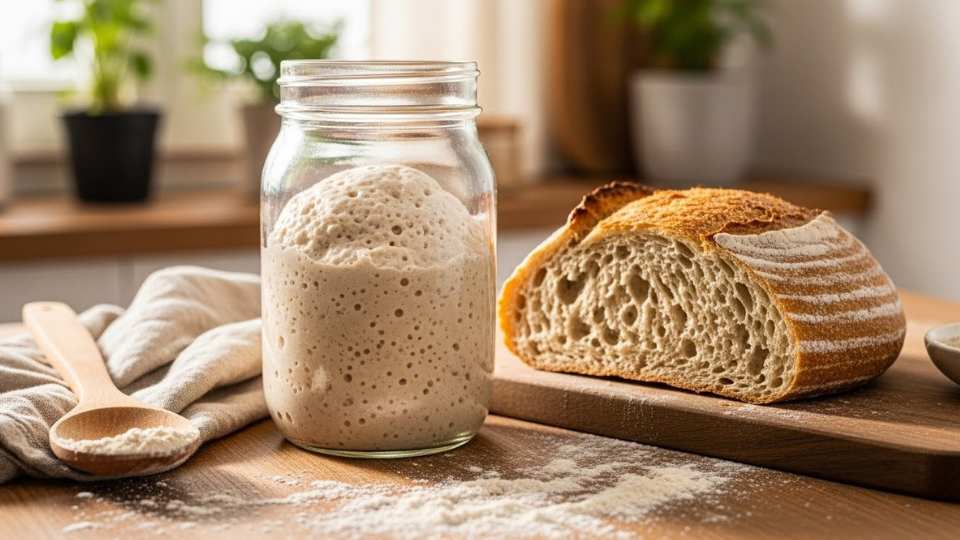
So you want to join the sourdough club?
Welcome! You’re about to embark on one of the most rewarding kitchen adventures ever. Fair warning though—sourdough can become an obsession. I started my first starter three years ago, and now I have friends texting me at midnight asking why their dough won’t rise. But honestly? I love it.
Creating a sourdough starter from scratch feels like magic. You’re literally cultivating wild yeast from the air around you, and in just seven days, you’ll have a living culture that can make bread for decades. Some bakers have starters that are over 100 years old, passed down through generations. How cool is that?
What Exactly Is a Sourdough Starter?
Before we dive into the how-to, let’s talk about what you’re actually making. A sourdough starter is a fermented mixture of flour and water that contains wild yeast and beneficial bacteria. These microorganisms work together to leaven bread naturally—no commercial yeast needed.
The wild yeast makes the bread rise, while the bacteria produce lactic acid and acetic acid, giving sourdough that distinctive tangy flavor. It’s the same fermentation process used in making pickled vegetables, just applied to dough instead.
The science is fascinating, but the practical result is what matters: amazing bread with complex flavors, better digestibility, and that gorgeous crusty exterior everyone loves.
What You’ll Need to Get Started
Ingredients (that’s it!):
- All-purpose flour or whole wheat flour (I prefer whole wheat for starting)
- Filtered or spring water (chlorinated tap water can inhibit fermentation)
Equipment:
- A clean glass jar (I use a quart-sized mason jar)
- A kitchen scale (seriously, get one—volume measurements are inconsistent)
- A rubber band or piece of tape
- A breathable cover (coffee filter, cheesecloth, or loose-fitting lid)
That’s literally everything you need. No fancy equipment, no expensive ingredients. Just flour, water, and patience.
According to baking experts at King Arthur Baking, the type of flour you choose can significantly impact your starter’s development speed and flavor profile, with whole grain flours typically fermenting faster due to higher nutrient content.
Day 1: The Beginning of Your Sourdough Journey
Morning (Day 1):
Mix 50 grams of flour with 50 grams of water in your jar. It should look like thick pancake batter. Scrape down the sides, mark the level with your rubber band or tape, cover loosely, and place it somewhere warm (around 70-75°F is ideal).
That’s it. Now wait.
What’s happening: You’ve created an environment where wild yeast and bacteria can grow. They’re in the flour, in the air, even on your hands. Right now, they’re just starting to wake up and multiply.
Evening (Day 1):
Check your starter. Honestly, you probably won’t see much activity yet, maybe a few tiny bubbles. That’s totally normal. Don’t panic. Just give it a gentle stir and cover it back up.
Day 2: The Quiet Period
Morning (Day 2):
You might see some bubbles forming, or you might not. Both scenarios are fine. Some starters wake up faster than others depending on your environment and the wild yeast present.
Discard half your starter (I know, it feels wasteful, but trust me). Add 50 grams of flour and 50 grams of water. Mix well, mark the new level, and cover.
Why discard? You’re managing the population of microorganisms and the acidity level. If you just keep adding flour and water without removing some, you’ll end up with way too much starter and an unbalanced ecosystem.
What to do with discard: Save it in a separate jar in the fridge. Use it for pancakes, crackers, or flatbreads.
Day 3-4: Things Start Getting Interesting
By day three or four, you should definitely see activity. Your starter might double in size within 12 hours of feeding. It’ll smell yeasty, slightly sweet, maybe a bit alcoholic. The surface might look bubbly or foamy.
Continue the same routine: discard half, feed with 50 grams flour and 50 grams water, twice a day if you’re seeing good activity.
Troubleshooting weird smells:
If your starter smells like nail polish remover or really strong alcohol, it’s hungry. Feed it more often or increase the amount of flour in each feeding. If it smells like rotten eggs or cheese, something went wrong—start over.
A good starter should smell pleasantly sour, yeasty, and slightly tangy. Kind of like yogurt meets beer. Sounds weird, tastes amazing in bread.
Day 5-7: Almost There!
By day five or six, your starter should be reliably doubling within 4-6 hours of feeding. The bubbles should be consistent throughout, not just on top. It should have a domed or slightly domed surface.
This is when you know it’s strong enough to leaven bread. But I always recommend waiting until day seven to ensure it’s really stable and active.
The float test: Take a small spoonful of starter and drop it in a glass of water. If it floats, it’s ready to bake with! If it sinks, give it another day or two of regular feedings.
For detailed information on sourdough fermentation science, Cultures for Health provides excellent resources backed by food science research.
Feeding Schedule After Day 7
Once your starter is established, you have options:
Option 1: Keep it at room temperature Feed it once or twice daily (every 12 or 24 hours). This keeps it very active and ready to bake with at any time. Good if you bake frequently.
Option 2: Refrigerate it Feed it, let it sit at room temperature for 30 minutes, then refrigerate. You only need to feed it once a week this way. Perfect for occasional bakers.
I keep mine in the fridge and pull it out the night before I want to bake. One feeding at room temperature, and it’s ready to go by morning.
Making Your First Loaf of Bread
Alright, your starter is ready. Now what? Here’s a super simple recipe to get you started:
Ingredients:
- 500g bread flour
- 350g water (70% hydration)
- 100g active sourdough starter (fed and bubbly)
- 10g salt
Process: Mix flour and water, let rest 30 minutes (this is called autolyse). Add starter and salt, mix until combined. Let it sit at room temperature for 4-6 hours, folding every 30 minutes for the first 2 hours. Shape, place in a proofing basket, refrigerate overnight. Bake in a Dutch oven at 450°F—30 minutes covered, 15-20 uncovered.
That’s the simplest version. As you get comfortable, you can experiment with different hydrations, fermentation times, and techniques.
Once your starter reliably doubles after feeding, use it in our homemade sourdough bread recipe. Baking gets easier as you adjust hydration, fermentation time, and shaping through practice.
Common Problems and Solutions
Problem: Starter isn’t rising Solution: Feed it more frequently, use warmer water (85-90°F), try whole wheat flour for more nutrients, or move it to a warmer spot.
Problem: Liquid on top (hooch) Solution: Your starter is hungry. Stir it back in or pour it off, then feed. Increase feeding frequency.
Problem: Mold Solution: Start over. Don’t try to save it. Mold means contamination, and it’s not safe.
Problem: Too sour Solution: Feed more frequently, use cooler water, reduce fermentation time in your dough.
Problem: Not sour enough Solution: Extend fermentation time, use warmer temperatures, try feeding less frequently.
The Art of Timing (This Is Key!)
Here’s what nobody tells beginners: timing matters way more than exact measurements. Your starter is a living thing influenced by temperature, humidity, and the specific microorganisms in your environment.
In summer, my starter doubles in 4 hours. In winter, it takes 8-10 hours. Both are fine—I just adjust my baking schedule accordingly.
Learn to read your starter instead of just following clock times. Is it bubbly? Domed? Does it smell right? That matters more than “it’s been exactly 6 hours.”
The same principle applies to bread making. Your dough is ready when it looks and feels ready, not when a recipe says it should be ready. Developing this intuition takes time, but it’s what separates okay bread from amazing bread.
Naming Your Starter (Yes, Really)
Okay, this sounds silly, but most serious sourdough bakers name their starters. Mine is called “Douglas” (I know, I know). There’s something about caring for a living culture that makes you treat it like a pet.
My friend’s starter is named “Bread Pitt.” Another friend has “Yeastie Boys.” The sourdough community gets weird with this, and it’s honestly one of the most charming parts of the hobby.
Plus, it makes it easier to talk about. “I need to feed Douglas” sounds way better than “I need to feed my flour-water mixture.”
The Sourdough Community
Speaking of community, sourdough bakers are some of the most helpful, enthusiastic people you’ll ever meet. There are countless Facebook groups, Reddit communities, and Instagram accounts dedicated to sourdough.
When I started, I joined r/sourdough on Reddit, and those people saved my starter multiple times with their advice. The community shares troubleshooting tips, recipes, and celebrates each other’s successes. It’s genuinely wholesome.
Similar to how traditional cooking techniques are passed down through generations, the sourdough community actively preserves and shares knowledge across borders and cultures.
Beyond Basic Bread: What Else Can You Make?
Once you’ve got bread down, the sourdough world opens up:
Sourdough pizza: The tanginess works perfectly with tomato sauce and cheese. Game-changing.
Sourdough pancakes: Use your discard for fluffy, flavorful pancakes. Add them to your weekend breakfast routine.
Sourdough crackers: Thin, crispy, and incredibly addictive. Perfect for cheese boards.
Sourdough English muffins: Better than store-bought, trust me.
Sourdough cinnamon rolls: The slight tang balances the sweetness beautifully.
Sourdough pasta: Yes, really. It’s a thing, and it’s amazing.
The possibilities are genuinely endless. Every recipe that uses flour can be adapted to use sourdough starter or discard.
The Mental Health Aspect (Unexpectedly Important)
I wasn’t expecting this, but maintaining a sourdough starter has been surprisingly good for my mental health. It’s a low-pressure routine that gives me something to care for without being overwhelming.
Feeding my starter takes maybe five minutes, but it gives me a sense of purpose and continuity. Even on rough days, I’ve kept something alive and thriving. That feels good.
Plus, the act of baking bread is meditative. Kneading dough, watching it proof, smelling fresh bread baking—these things genuinely reduce stress. Multiple studies have shown that baking can improve mental wellbeing, and I’m living proof.
For more on the therapeutic aspects of cooking, The Guardian has published several articles exploring the connection between baking and mental health.
Cost Analysis: Is Sourdough Worth It Financially?
Let’s be real about money. A good artisan sourdough loaf costs $6-8 at bakeries. Making it yourself costs maybe $1 in flour and electricity. Even factoring in the initial time investment, you break even after a few loaves.
Plus, you can make pizza, pancakes, crackers, and other foods from the same starter. The economics actually make sense, especially if you were buying quality bread regularly anyway.
The startup cost is minimal—maybe $10 for a jar and a bag of flour. Compare that to hobbies like golf or photography, and sourdough is incredibly affordable.
Your Starter Can Outlive You
Here’s something beautiful to think about: a well-maintained starter can last indefinitely. There are bakeries using starters that are over 150 years old. The Boudin Bakery in San Francisco has used the same mother dough since 1849.
You could start a culture today that your grandchildren use. That’s not just baking—that’s creating a legacy. Every loaf they make will contain yeast descended from the culture you started.
Some families pass down starters like heirlooms. I’ve heard stories of people dividing starters among children at holidays, each kid getting a portion of the family culture to maintain. How cool is that?
Final Encouragement: You Can Do This
Look, I’m not going to lie—your first loaf probably won’t be perfect. Mine was dense, misshapen, and under-baked. But it was MY bread, made with MY hands, using wild yeast I cultivated from nothing.
That second loaf was better. The tenth loaf was actually good. By loaf twenty, I was making bread that rivaled good bakeries. It just takes practice and patience.
The most important thing? Don’t give up after one failure. Sourdough has a learning curve, but it’s not as steep as people make it sound. Humans have been making sourdough for thousands of years without thermometers or timers or Instagram tutorials. You can definitely figure this out.
Start your starter today. In one week, you’ll have a living culture. In two weeks, you’ll have made your first loaf. In a month, you’ll be that person boring everyone at parties by talking about your starter’s feeding schedule.
Welcome to the club. We’re glad you’re here. Now go make some bread!