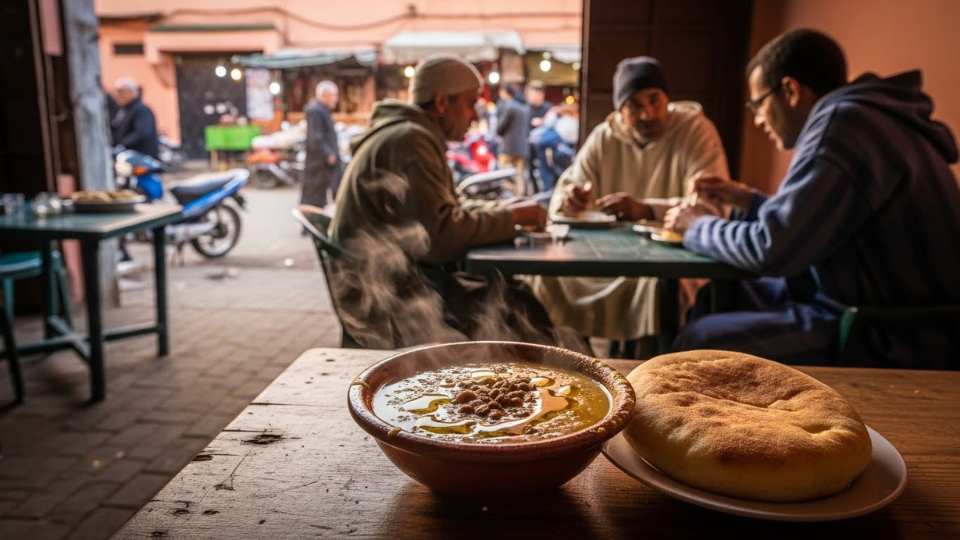
Every guidebook tells you to eat tagine in Marrakech. Almost none tell you where actual Moroccans eat.
I spent three weeks in Marrakech eating everywhere from fancy riads to sketchy street corners, and the best meals happened in places with no Morocco’s Secret Food English signs, no menus, and definitely no tourists. Let me show you the Marrakech that food tours miss completely.
The Tourist vs. Local Food Morocco’s Secret Food Divide
Here’s something nobody mentions: the food tourists eat in Marrakech and the food locals eat are almost completely different cuisines. Tourists eat tagine, couscous, and bastilla. Locals eat those things too, but rarely, and definitely not the versions served in tourist areas.
The tagine you’re eating in the medina? It’s been sitting in that clay pot for hours, reheated multiple times, over-sweetened for Western palates. The couscous? Probably instant, not hand-rolled. The prices? Marked up 300% because they know you don’t know better.
Real Moroccan food happens in neighborhood spots where the menu is whatever they’re making that day, where old men play cards while eating, where the only decoration is a calendar from 2019, and where “tourist price” isn’t a concept because tourists never find these places.
Breakfast Like a Local: The Bessara Experience
My first revelation happened at 7 AM in a tiny spot near Bab Doukkala. I’d been following a group of construction workers, figuring they’d know where to find good, cheap breakfast.
They led me to a place with no name, just an old man serving bowls of thick, steaming soup from a massive pot. This was bessara—fava bean soup—and it’s what working-class Moroccans eat to start their day.
The soup arrived with olive oil drizzled on top, cumin sprinkled over, and fresh bread for dipping. Cost: 7 dirhams, which is about 70 cents. It was thick, hearty, slightly bitter from the beans, warming from the cumin, rich from the olive oil. One bowl kept me full until 2 PM.
Nobody spoke English. The old man running the place just ladled soup into bowls and handed them out. You eat standing up or sitting on the curb outside. There’s no table service, no napkins, no frills. Just really good soup and fresh bread.
According to food historians at Saveur, bessara represents one of Morocco’s oldest dishes, predating the tourist-oriented tagine culture by centuries and remaining a daily staple for working-class families.
Lunch at the Mechanics’ District: Where Real Kefta Lives
The Marrakech industrial district near the bus station isn’t in any guidebook. It’s loud, dusty, and full of auto repair shops. It’s also where you find the best kefta (Moroccan meatballs) in the city.
A taxi driver told me about this area after I asked where he eats. He looked at me skeptically—I was clearly a tourist—but gave me an address when I insisted I wanted “real Moroccan food, not tourist food.”
The restaurant was a concrete room with plastic tables. The menu was written in Arabic on a chalkboard I couldn’t read. I pointed at what the table next to me was eating—a tagine of kefta in tomato sauce with a fried egg on top.
What arrived looked nothing like the tourist tagines I’d seen. The sauce was deeply savory, not sweet at all. The kefta were well-spiced with cumin, coriander, and lots of fresh herbs. The egg yolk, when broken, mixed with the sauce to create this rich, luxurious coating for the bread.
Cost: 35 dirhams with bread and salad. About $3.50 for a massive, satisfying meal that kept me full for eight hours. The men eating around me were mechanics on lunch break, construction workers, and local shop owners. Not a tourist in sight.
The Secret Snack: B’ssara on Every Corner
Once I knew what b’ssara was, I started noticing it everywhere locals gathered. Unlike the morning bessara (fava bean soup), b’ssara is a thick fava bean dip served with olive oil and cumin.
Street vendors sell it from carts in working-class neighborhoods—Sidi Youssef Ben Ali, Daoudiate, areas tourists never venture into. You get a bowl of b’ssara, bread, olives, and mint tea for less than a dollar.
I watched how locals ate it: tear bread, dip generously in the thick b’ssara, drag it through the olive oil and cumin pooled on top. The texture is somewhere between hummus and refried beans. The flavor is earthy, rich, and surprisingly addictive.
This became my regular afternoon snack when exploring non-touristy neighborhoods. It’s filing, cheap, and every cart makes it slightly differently depending on their spice blend.
Similar to discovering authentic street food in other countries, finding real Moroccan food requires venturing beyond tourist zones and following local crowds.
Friday Couscous: The Actual Tradition
Friday is couscous day in Morocco. Families make it after mosque, and it’s a whole production—hand-rolling the couscous, slow-cooking the vegetables, preparing various toppings.
But locals don’t eat it in restaurants—they eat it at home. The “couscous” restaurants in the medina are for tourists who don’t know better. However, there’s a workaround.
Several small spots in residential areas serve Friday couscous made by local women cooking from their homes. These are technically restaurants but feel more like eating in someone’s living room. No English spoken, no printed menu, just whatever they made that day.
I found one near the Mellah (Jewish quarter) through a recommendation from my riad owner’s mother. The couscous arrived on a massive communal platter—fine-grained couscous topped with slow-cooked vegetables (seven kinds is traditional), tender lamb, chickpeas, and that beautiful broth poured over everything.
You eat with your right hand, making small balls of couscous and vegetables, using bread as a scoop. Everyone at the table shares from the same platter. It’s intimate, traditional, and absolutely delicious.
Cost: 60 dirhams per person, which is higher than street food but still only about $6. And this was real, home-cooked couscous that took someone hours to prepare.
Street Food After Dark: The Tangia Carts
Jemaa el-Fnaa square after dark is full of food stalls serving tourists. The prices are high, the food is mediocre, and you’ll probably get sick. Don’t eat there.
Instead, walk 15 minutes to Bab Doukkala and look for the tangia carts that set up around 9 PM. Tangia is a traditional Marrakech dish—meat slow-cooked in a clay pot with preserved lemon, garlic, and spices, then buried in the ashes of a hammam (bathhouse) fire.
These street vendors dig the tangia pots out of the ground where they’ve been cooking for hours. They open them tableside, releasing this incredible fragrant steam. The meat is falling-off-the-bone tender, infused with smoky flavor from the fire and bright acidity from the preserved lemon.
You eat it with bread, pulling chunks of meat straight from the pot. It’s primal, delicious, and costs about 40 dirhams ($4). The vendors are there until about 2 AM, serving local workers, late-night diners, and the occasional tourist who got good advice.
Harira That Doesn’t Suck
Harira is Morocco’s famous lentil-tomato soup, traditionally served to break fast during Ramadan. Tourist restaurants serve it year-round as a starter, and it’s usually watery and bland.
Real harira is thick, complex, and requires hours of cooking. It has lentils, chickpeas, tomatoes, lamb, fresh herbs, and a long spice list. When done right, it’s substantial enough to be a meal.
The best harira I found was at a tiny spot in the Mellah that only opens from 6-10 PM. The owner, an older woman, has been making the same harira recipe for 35 years. Her soup was so thick you could almost eat it with a fork.
She served it with dates and chebakia (sesame cookies) for dipping, which is the traditional way. The sweet dates cut the savory soup’s intensity. The cookies soaked up the broth. It was a flavor combination I’d never considered but immediately understood.
Cost: 12 dirhams (about $1.20) for a massive bowl with dates and cookies included. I went back four times in three weeks.
The Bread Culture Nobody Explains
Moroccan bread (khobz) isn’t just a side dish—it’s the utensil, the starch, and half the meal. Every neighborhood has a communal oven (ferran) where locals bring their dough to be baked.
Walk through residential areas around 11 AM or 5 PM, and you’ll see people carrying dough on wooden boards, heading to the communal oven. Twenty minutes later, they’re walking back with hot, crusty bread.
I started buying my bread at these communal ovens instead of shops. Cost: 1 dirham (10 cents) for a massive round loaf that’s still warm. The bread is crusty outside, soft inside, with a slight sourdough tang from natural fermentation.
Watch how locals use bread: rip off a piece, fold it to create a scoop, use it to pinch meat or vegetables, soak up sauce. Your hands stay relatively clean, and the bread tastes better because it’s soaked up all those flavors.
For more on traditional bread cultures around the world, King Arthur Baking provides fascinating historical context on communal baking traditions.
Mint Tea: The Social Glue
Moroccan mint tea isn’t just a drink—it’s the foundation of social interaction. Every encounter involves tea: business meetings, friendly visits, after meals, random conversations with strangers.
The tea served to tourists is often weak, over-sugared, and served without ceremony. Real Moroccan tea culture is different.
I learned the proper tea ritual from a carpet seller who insisted on teaching me before we discussed carpets. Green tea, fresh mint, and lots of sugar are boiled together. The tea is poured from a height to create foam (essential!). The first glass is bitter, the second is perfect, the third is getting weak.
You’re supposed to have at least three glasses. Accepting only one is considered rude. The tea is the excuse to sit, talk, and take time with human interaction in a world that’s always rushing.
I started going to small neighborhood tea houses where old men gather to play cards and drink tea all afternoon. For 5-10 dirhams, you can sit for hours, and nobody rushes you. It’s social lubricant, caffeination, and meditation all in one.
The Market Meals Locals Actually Eat
Tourists visit the souks to shop. Locals visit the souks to eat. Inside the covered markets are tiny restaurants serving workers, and this is where you find some of the most authentic food.
There’s a grilled meat section in the Mellah market where butchers grill liver, heart, kidneys, and other offal over charcoal. You can smell it from blocks away. Locals order mixed grill plates—a bit of everything—served with bread, harissa, and cumin.
I was hesitant about organ meats, but when in Marrakech… The liver was tender and not at all gamey when cooked fresh. The heart had a meaty, almost steak-like texture. The kidneys were the only thing I couldn’t fully get into, but locals devoured them.
Cost: 30-40 dirhams for a huge plate. The grilling happens right in front of you, so you know everything’s fresh and cooked to order.
Breakfast Part Two: The Msemmen Experience
Msemmen are flaky, square Moroccan pancakes that are nothing like American pancakes. They’re made from semolina dough that’s folded multiple times with oil, creating hundreds of crispy layers.
Every neighborhood has a women-run stand making fresh msemmen to order. You can see the process: rolling thin dough, folding it square, cooking it on a griddle until both sides are golden and crispy.
The locals eat them with honey and butter, or with savory fillings like cheese and olives. I preferred the sweet version—the contrast between crispy exterior and chewy interior, all soaked in butter and honey, was incredible.
These cost 2-3 dirhams each (20-30 cents). I’d eat three for breakfast with mint tea, and that sustained me for hours of walking around the city. Much better than the hotel breakfast I’d paid extra for.
How to Find These Places Yourself
You’re not going to find these spots on Google Maps or in guidebooks. Here’s how to actually locate authentic local food:
Ask taxi drivers where they eat. They know. Offer to buy them tea and they’ll give you addresses and directions.
Follow local workers at meal times. Construction workers, shop owners, and deliverymen eat well and cheaply. Track them.
Look for places with no English. If the sign is only in Arabic and the menu isn’t translated, you’re probably in the right place.
Eat where old men gather. Moroccan older men are picky about food quality and don’t tolerate tourist nonsense. Where they eat is where you should eat.
Go to industrial neighborhoods. The Medina is for tourists. Real life happens in less picturesque areas.
Use the phrase “wein kayklo l-maghribiyyin?” (Where do Moroccans eat?). If someone speaks French, try “Où mangent les Marocains?”
Price as a Quality Indicator
Here’s a counterintuitive truth: in Marrakech, cheaper often means better when it comes to local food. Expensive restaurants cater to tourists and expatriates. Cheap spots serve locals who wouldn’t tolerate bad food.
If a meal costs less than 50 dirhams ($5), it’s probably authentic. If it costs more than 100 dirhams ($10), you’re paying for ambiance, not better food. The best meals I had cost 20-40 dirhams.
The exception: home-cooking experiences where someone invites you to eat in their actual home. These cost more but provide genuine cultural exchange and incredible food.
Safety and Hygiene Concerns
“But is it safe?” Everyone asks this about street food. Here’s the truth: I ate at dozens of these local spots and never got sick. Not once.
Why? Because turnover is high—food doesn’t sit around. Cooking temperatures are high—everything’s grilled or boiled fresh. And locals eat there—if it was making people sick, it would shut down fast.
The places that made tourists sick? Mostly the touristy spots in Jemaa el-Fnaa where food sits under lights for hours, reheated multiple times.
Use common sense: eat at busy places, avoid anything that’s been sitting out, watch your food being cooked when possible. You’ll be fine.
What I Learned From Three Weeks of Local Eating
The Marrakech food scene has two parallel tracks. There’s the tourist track: tagine, couscous, mint tea, bastilla, overpriced and underwhelming. Then there’s the local track: bessara, b’ssara, tangia, real couscous on Fridays, communal bread, mint tea with meaning.
Staying on the tourist track isn’t wrong—those restaurants serve decent food in comfortable settings. But you’re missing the actual culture, the real flavors, and the human connections that come from eating where locals eat.
The best moments of my trip happened in these local spots: playing cards with old men over mint tea, sharing a communal couscous platter with a family who spoke no English, watching the sun rise while eating bessara with construction workers.
That’s not just eating—that’s understanding a place through its food culture. And that’s worth way more than another tourist tagine in the medina.
If you make it to Marrakech, spend at least a few meals stepping outside your comfort zone. The food is better, the prices are lower, and the experiences are unforgettable. Just bring an adventurous spirit and an empty stomach.
